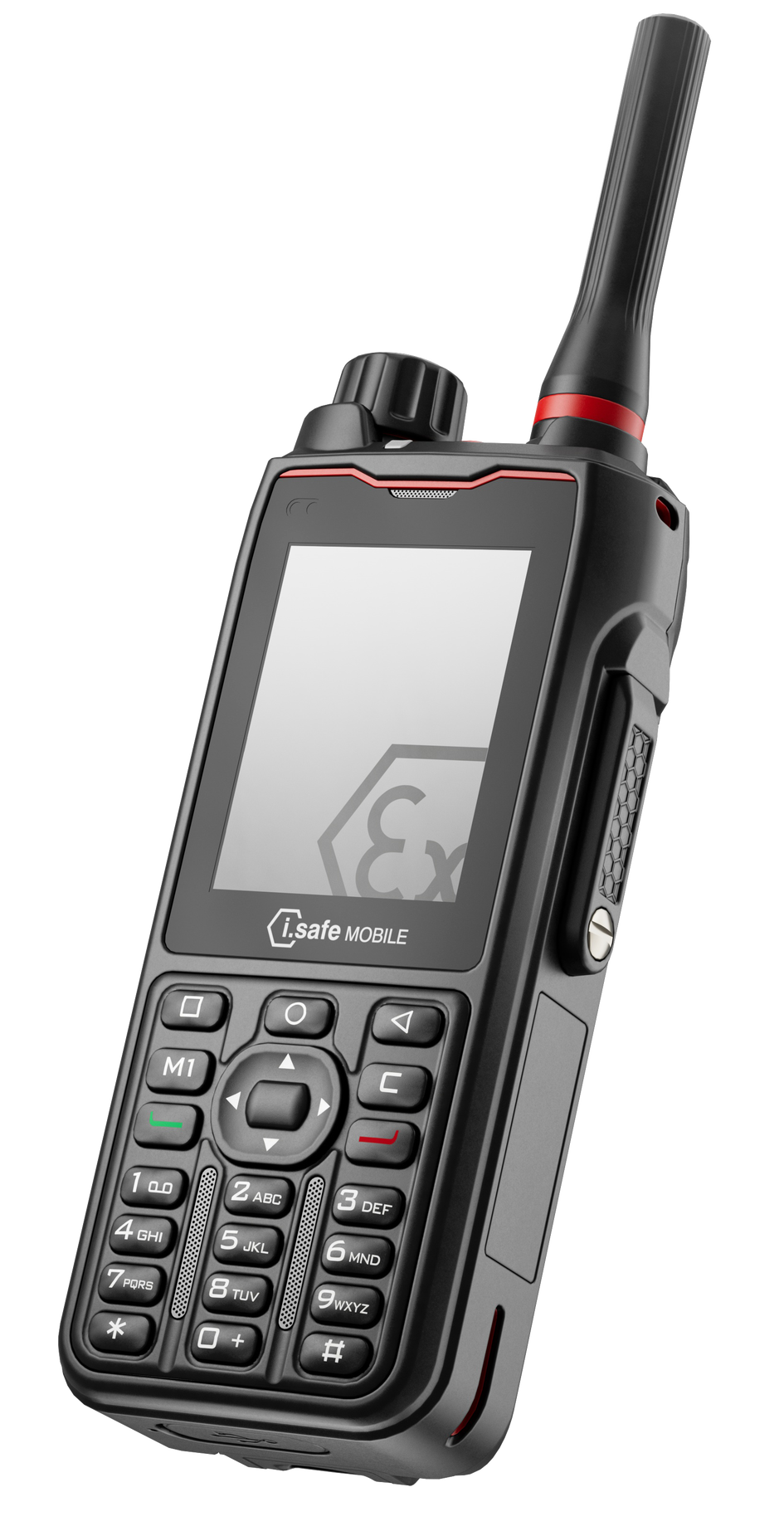
The i.safe MOBILE IS380.1 is designed to feel immediately familiar. Anyone who has used a two-way radio will recognise its shape, its side-mounted push-to-talk button and the rotary control positioned on the top of the unit. In the hand, it behaves exactly as you would expect. You press the button, speak, and your voice is heard by others in your group.
What distinguishes the IS380.1 is not how it feels to operate, but how it carries your voice. Instead of transmitting over traditional VHF or UHF radio frequencies, it uses a 4G mobile network and a Push-to-Talk over Cellular platform to deliver communication. That difference sits beneath the surface, yet it changes how organisations can think about coverage, scalability and long-term communication strategy.
Moving Beyond Site-Bound Radio Coverage
Traditional radio systems remain widely used across UK industry because they are dependable and straightforward. A typical setup involves handheld radios communicating either directly with one another or through repeaters and base stations that extend coverage across a defined site. Within that footprint, communication is fast and predictable.
However, the boundaries of the system are physical. Coverage is determined by infrastructure and terrain. Expanding beyond a single site often requires additional repeaters, careful frequency management and ongoing maintenance. Linking separate facilities together can become complex, particularly where operations are spread across regions.
As mobile network coverage has strengthened over recent years, particularly in industrial and transport environments, organisations have begun to explore alternative ways of delivering voice communication. Rather than relying entirely on fixed radio infrastructure, it is now possible to transmit voice as secure data across national mobile networks. This is where Push-to-Talk over Cellular becomes relevant.
How Push-to-Talk Over Cellular Works
Push-to-Talk over Cellular, commonly referred to as PTToC, is designed to replicate the simplicity of radio communication while operating over broadband networks. When a user presses the PTT button on the IS380.1, their speech is converted into digital data and transmitted via 4G to a communication platform. That platform immediately distributes the audio to all devices within the selected talk group.
From an operator’s perspective, the experience remains consistent with traditional radio. There is no dialling sequence and no waiting for a call to connect. Communication is initiated by pressing the button, and speech is delivered to the group almost instantly. The difference lies in the underlying network, not in the workflow.
Because the system relies on mobile coverage rather than site-based repeaters, the potential communication area expands significantly. Teams can remain connected across multiple locations, between depots or even nationally, provided mobile coverage is available. For organisations with geographically dispersed operations, this represents a meaningful shift.
Introducing Change Without Disruption
In practice, organisations wouldn’t typically replace their entire radio infrastructure overnight. The IS380.1 supports a gradual approach. It is common to begin by equipping supervisors, maintenance managers or multi-site engineers with PTToC devices while operational teams continue using traditional radios. These roles often benefit most from extended coverage and cross-site communication.
As confidence builds and the operational advantages become clearer, additional teams may transition. Some organisations ultimately retire their radio infrastructure altogether, while others operate a hybrid arrangement for a period of time. The pace and structure of migration depends on operational requirements rather than device limitations.
Where interoperability between conventional radios and PTToC devices is required, this can be achieved through Radio over IP integration. Such systems act as a bridge between RF radio networks and broadband communication platforms, translating audio between the two. This is a network-level solution rather than a feature of the handset itself, and it forms part of a wider communication strategy rather than a simple hardware decision.
Engineered for Real-World Hazardous Area Use
One of the reasons the IS380.1 is effective in industrial environments is that it preserves the physical characteristics operators expect. Gloves, background noise and long shifts all influence device design. The large PTT button allows confident use without visual confirmation. The rotary control provides intuitive adjustment of channels or volume. The front-facing amplified loudspeaker supports clarity in demanding acoustic conditions. A replaceable battery allows for quick turnarounds between shifts to keep the devices operational for as long as possible.
Although the device operates on an Android-based platform and integrates with modern communication systems, these capabilities remain deliberately in the background. The technology supports the user rather than reshaping the way they work. For many organisations, maintaining that familiarity is essential when introducing new communication methods.
Where the IS380.1 Sits in the Communication Landscape
It can be helpful to view communication systems along a spectrum. At one end are conventional RF radios, which are localised and infrastructure-dependent but well understood. At the other end are fully integrated broadband communication environments built around private LTE or 5G networks.
The IS380.1 occupies the space between these positions. It delivers broadband Push-to-Talk functionality using existing 4G networks while retaining the ergonomics and operational logic of a traditional radio. It enables organisations to expand coverage and introduce digital communication capabilities without committing immediately to complex private network deployments.
For many UK industrial operators, that balance is precisely what is required. The device allows communication systems to evolve in step with operational needs rather than forcing a wholesale transition.
A Practical Step Forward
Understanding the IS380.1 means recognising that it is neither a conventional radio nor a standard smartphone. It is a purpose-built 4G communication device designed to preserve established working practices while extending what is technically possible.
For organisations seeking wider reach, improved flexibility and a structured path towards modern communication infrastructure, it provides a practical and measured step forward. By combining familiar operation with broadband connectivity, it allows voice communication to move beyond site boundaries without losing the simplicity that makes radio systems effective in the first place.
Looking Ahead: Where 5G Radios Fit
The IS380.1 sits comfortably in organisations that are extending communication beyond site boundaries using public 4G networks. For many operators, that is the right starting point. It allows teams to move away from purely local radio infrastructure without committing immediately to a more complex communications redesign.
There is, however, a broader conversation emerging around private 4G and private 5G networks in industrial environments. Larger facilities, ports and energy sites are beginning to deploy their own dedicated mobile networks on site. This gives them greater control over coverage, resilience and network performance, particularly where communication is tightly integrated with operational systems.
This is where devices such as the i.safe MOBILE IS440.1 start to enter the discussion.
Where the IS380.1 typically relies on public 4G infrastructure as a practical way to extend communication reach, the IS440.1 is positioned for organisations that are designing long-term broadband communication environments, including private 5G deployments. It follows the same Push-to-Talk over Cellular principles, but sits further along the infrastructure planning curve.
For many industrial operators, that stage comes after they have proven the value of 4G-based communication. The starting point is often extending what they are currently using and then following this comes further control through the deployment of private 5G networks.
We will explore that distinction in more detail in the future, focusing specifically on how 5G radio devices differ from 4G migration devices and when that additional capability becomes operationally relevant.