If you are looking for a safety relay for a SIL 3 application, the SIL requirement is obviously one of the first things to establish. What is less obvious is that it does not necessarily tell you which type of relay you need. Different applications can place very different demands on the relay, depending on what is being controlled, how important continued process operation is and how much information needs to be passed back to the control system.
That is the thinking behind a recent group of safety relay solutions highlighted by GM International. Rather than presenting one relay as suitable for every situation, the range shows how different application requirements can lead to quite different solutions. For somebody comparing products, that is probably the most useful way to look at the subject: start with what the relay actually needs to do, then look at which features are relevant.
Start with what the relay needs to do
One of the simplest differences is the number and type of loads being controlled. Some applications may only need a relatively straightforward switching function, while others need to operate several loads from the same control signal or accommodate a mixture of normally energised and normally de-energised equipment. GM International's D5290S-078 is designed for this type of requirement, providing a flexible relay arrangement for controlling multiple NE and ND loads.
The important point is not the number of contacts listed on the datasheet. It is that the arrangement needs to suit the application. A relay with additional contacts or configuration options only adds value if the system actually needs them. Starting with the load therefore gives a much clearer basis for comparing products than simply looking for the highest specification available.
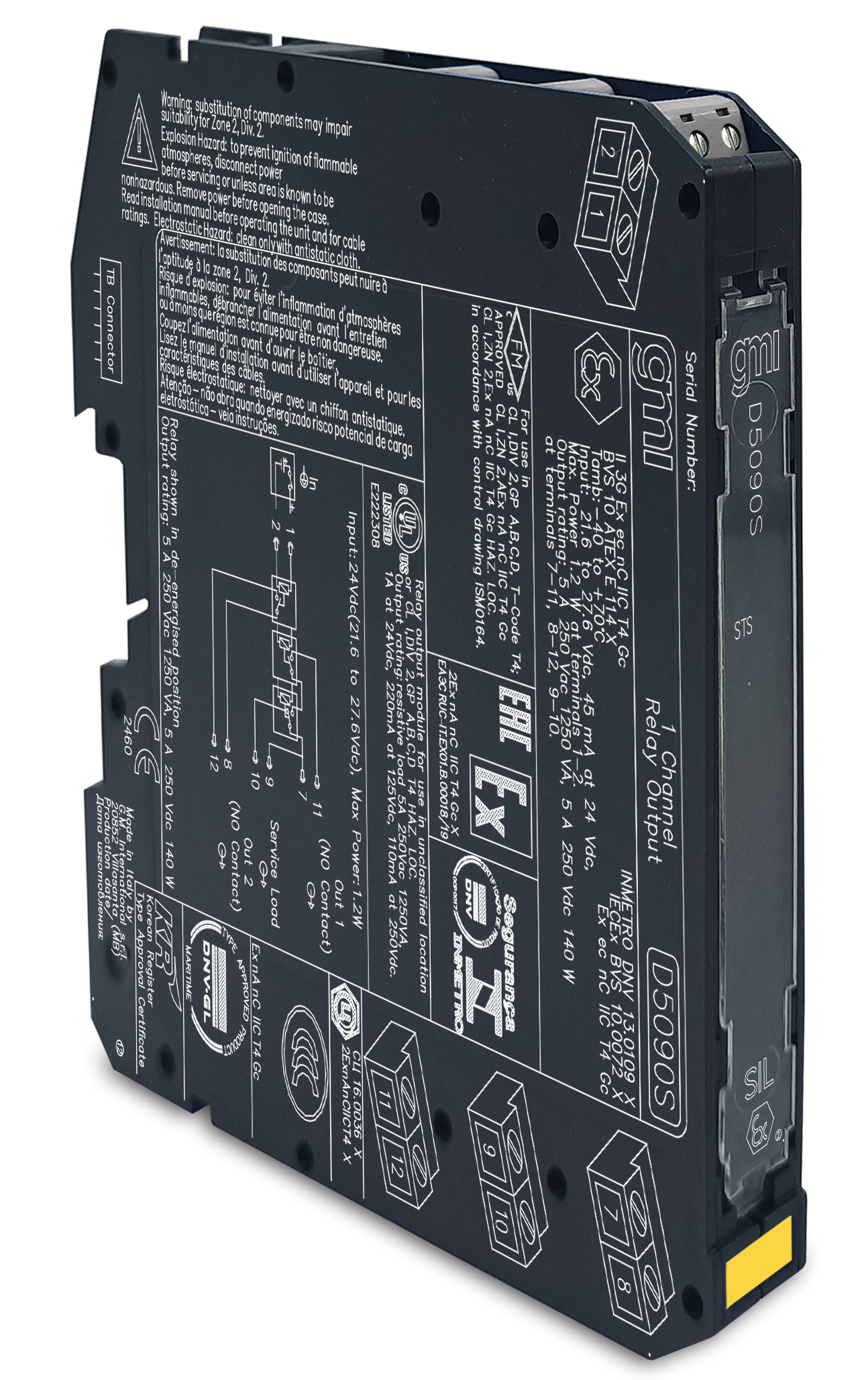
The same principle applies when process availability becomes more important. A safety system must be able to move equipment to a safe state when required, although an unnecessary process shutdown can still be disruptive and expensive. GMI's D5094S is designed for applications where reducing the likelihood of this type of spurious trip is particularly important. Its relay arrangement is intended to increase process availability while still supporting SIL 3 safety-related applications.
That does not mean every installation needs a high-availability relay. It simply introduces another question into the selection process. If an unnecessary shutdown would have a significant operational impact, process availability may deserve more attention than it would in an application where a short interruption is relatively straightforward to manage.
How much diagnostic information is needed?
Another difference appears when the control system needs more information about what is happening in the circuit. A conventional relay may be perfectly suitable for switching a load, but some applications also require additional monitoring so that faults elsewhere in the circuit can be identified.
GM International's D5096S is designed for this type of requirement. According to GMI, the module can help identify faults such as a break or short circuit in the line, as well as problems with the voltage supplied to the load. This means the relay is doing more than simply passing a switching command between the control system and the field device; it can also provide additional information about the condition of the circuit.
Again, this comes back to the application rather than assuming more features are automatically better. If detailed fault information is important to the way the plant is monitored or maintained, this type of diagnostic capability becomes useful. If the requirement is simply to switch a load safely, that additional functionality may not be necessary.
Not every application is about switching a load
There are also situations where the requirement is slightly different again. GM International's D5093D/S devices are designed to detect AC or DC input signals rather than simply acting as conventional relay-output modules. GMI describes them as suitable for detecting signals between 24 and 220 Vac/Vdc and reproducing their status at the output.
This is probably the clearest example of why beginning with the application makes more sense than beginning with a product list. All of these devices sit within the wider area of SIL 3 safety-related applications, but they are solving different problems. One application may need to control several loads, another may place greater importance on avoiding unnecessary trips, another may require more detailed fault information, while another may simply need to detect the state of an electrical signal.
Once those requirements are understood, the specifications become much easier to interpret. The required SIL remains fundamental, but it is only part of the selection. Understanding what needs to be controlled, how the process should behave and what information needs to be available to the control system helps narrow the choice much more effectively.
GM International offers a range of safety relay and signal interface solutions for these different requirements. Exloc is the UK and Ireland distributor for GM International, so if you have an application and are unsure which approach is most appropriate, we can help identify the relevant options from the GMI range.