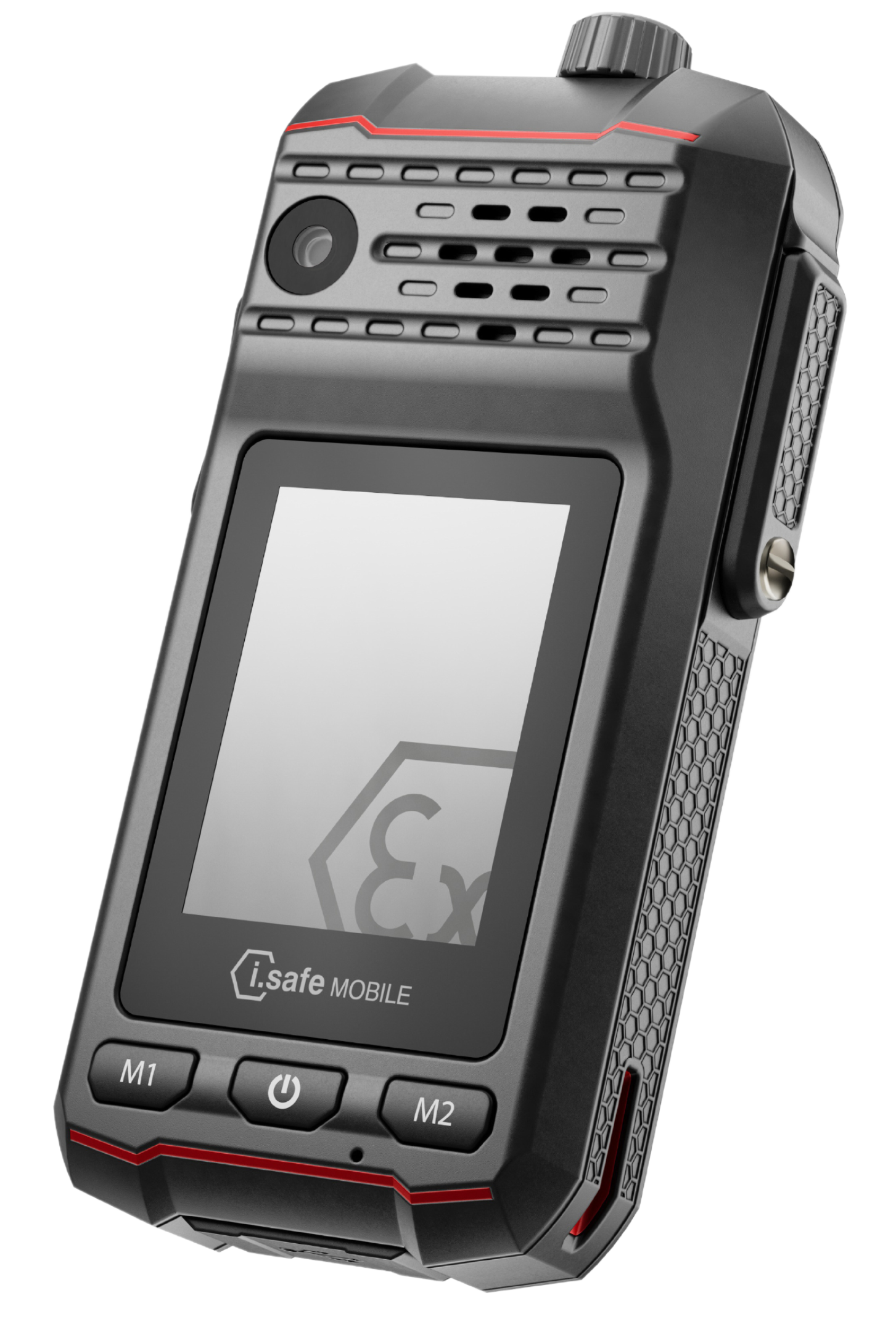
The i.safe MOBILE IS440.1 looks and behaves much like a radio. It has a large push-to-talk button on the side, a rotary selector on the top, an amplified front-facing speaker and programmable controls that can be used without navigating through a smartphone-style interface. For an operator using it primarily for voice communication, the experience can remain very simple: select the appropriate talkgroup, press the button and speak. That familiarity is deliberate, because the technology behind the communication is quite different from a conventional two-way radio.
The IS440.1 is designed for Push-to-Talk over Cellular communication across public or campus 4G and 5G networks, as well as Wi-Fi. Instead of voice being carried over conventional VHF or UHF radio frequencies, communication is handled through a compatible Push-to-Talk application and transported over the available broadband network. From the operator’s point of view, very little necessarily changes. From an infrastructure point of view, almost everything can.
From radio coverage to broadband infrastructure
In our earlier article on understanding the IS380.1, we looked at how Push-to-Talk over Cellular changes one of the basic limitations of a conventional radio system. Traditional radio coverage is normally designed around a defined physical area, using repeaters and supporting infrastructure to provide communication where it is required. Once the user moves beyond that coverage footprint, the system itself becomes the limitation. Push-to-Talk over Cellular changes that relationship by moving the communication onto broadband networks instead.
The IS440.1 works on the same underlying principle, although it opens up a broader range of network options. It can communicate over existing public mobile networks, which can be useful where suitable coverage is already available, or it can operate as part of a private 4G or 5G deployment built specifically around a site. That difference matters because the network is no longer simply something outside the organisation that the device happens to connect to. In a private network deployment, the mobile infrastructure itself can become part of the site’s communications system.
This changes the way coverage can be approached. Instead of asking only whether a public network reaches a particular production area, warehouse, process plant or external location, the organisation can consider where its own network needs to provide coverage and what applications will depend on it. Push-to-Talk voice may be one of those applications, but it does not have to be the only one. The significance of 5G in this context is therefore not simply greater speed. Voice communication itself does not need the sort of bandwidth normally associated with 5G. The more useful distinction is that the IS440.1 can operate as part of a broadband environment capable of supporting a wider range of connected services.
The radio is only one part of the system
A useful way of understanding the IS440.1 is to separate the device from the system around it. The radio is the part carried by the operator, but it does not create the Push-to-Talk environment on its own. The 4G, 5G or Wi-Fi network provides connectivity, while a compatible third-party Push-to-Talk application manages the communication itself, including functions such as users and talkgroups. This separation is important because the IS440.1 is not tied to one particular PTT service or one particular type of mobile network. Its role depends partly on the infrastructure and software it is connected to.
That also helps explain how broadband communication can be introduced without necessarily removing an existing conventional radio system at the same time. Where communication is required between the IS440.1 and traditional radio users, an appropriate gateway can bridge the two systems. The IS440.1 is not switching between cellular communication and conventional radio transmission itself; the integration happens elsewhere in the communications architecture. For sites with a substantial existing radio network, that makes migration more flexible because conventional radio and broadband Push-to-Talk can potentially continue to operate alongside each other where there is a practical reason to retain both.
The device therefore becomes easier to understand once it is viewed as an endpoint within a wider communications system. The operator sees a radio and interacts with it like a radio, while the network, application and any integration with existing systems sit behind that experience. Much of the complexity can remain away from the person who simply needs to communicate.
More capability without losing the radio workflow
The physical design of the IS440.1 reflects that separation between what the operator needs to do and what the technology is capable of doing. Large PTT and programmable buttons reduce the need to work through menus during normal use, while the rotary control can be used with compatible applications for functions such as talkgroup selection. The amplified front speaker is designed for communication in noisy environments, and the battery is replaceable, which is useful where devices need to remain in service across shifts.
The wider capability only becomes relevant when it changes what the device can contribute beyond basic voice communication. The IS440.1 runs i.safe MOBILE’s ISM-OS and supports selected applications through the pre-installed App World, including compatible Push-to-Talk and mobile device management solutions. It also includes a front-facing camera, positioning technology and sensors, giving suitable applications access to information that a traditional voice-only radio would not normally provide.
Those features do not mean every deployment needs to turn the IS440.1 into a multifunction device. In many cases, its main job may still be straightforward Push-to-Talk communication, and there is value in keeping that interaction simple. The difference is that voice no longer has to sit inside a completely separate communications system. A device operating on a broadband network can also form part of wider workflows where that is useful, whether that involves device management, visual information, positioning or other connected functions supported by the chosen applications.
This is where the distinction between a radio and a broadband communications device starts to become clearer. The IS440.1 retains the physical controls that make radio communication practical, while the technology underneath gives the organisation more options in how that communication fits into the rest of its infrastructure.
Where the IS440.1 sits alongside the IS380.1
Looking at the IS380.1 and IS440.1 simply as a 4G radio and a 5G radio misses much of the difference between them. The IS380.1 is particularly easy to understand as a migration device. It allows organisations to introduce broadband Push-to-Talk while retaining the familiar physical operation of a conventional radio, making it possible to move beyond the fixed coverage of an existing radio network without asking users to adopt a completely different way of communicating.
The IS440.1 builds on the same idea, but it is designed to sit comfortably within a broader broadband communications environment. It can still use public cellular networks, so choosing the IS440.1 does not automatically mean deploying a private 5G network. Where the distinction becomes more meaningful is on sites that are already considering, or beginning to develop, their own mobile infrastructure and want communication devices that can sit within that wider strategy.
A site using a public mobile network may simply be looking for a practical way to extend Push-to-Talk communication beyond conventional radio coverage. A site building a private 4G or 5G network is making a larger infrastructure decision. Push-to-Talk may be one part of that network, alongside other connected applications that rely on the same underlying coverage. The additional capability of the IS440.1 makes more sense in that context because the device can remain straightforward for the operator while participating in a much broader communications environment.
That is probably the most useful way to understand the IS440.1. It is not simply a conventional radio with 5G added to it, nor does using one automatically mean replacing an existing radio system or building a private network. It is a purpose-built hazardous-area communications device designed around familiar radio working practices, but able to operate within modern broadband infrastructure where the network and software become just as important as the handset itself.
For organisations moving towards broadband Push-to-Talk or private mobile networks, this combination is what makes the IS440.1 particularly interesting. It keeps the simplicity and familiarity of a purpose-built radio for the person using it, while providing the connectivity and application support needed to become part of a much more capable communications environment. The result is a device that can fulfil the straightforward job of push-to-talk communication today without limiting what the wider communications system may need to support around it.
If you are considering the IS440.1, Push-to-Talk over Cellular or how broadband communications could fit alongside an existing radio system, Exloc can help you assess the options and identify the most suitable approach for your site and application.